
Bedroom Guides
Ideal Bed Size and Bedroom Layout Guide
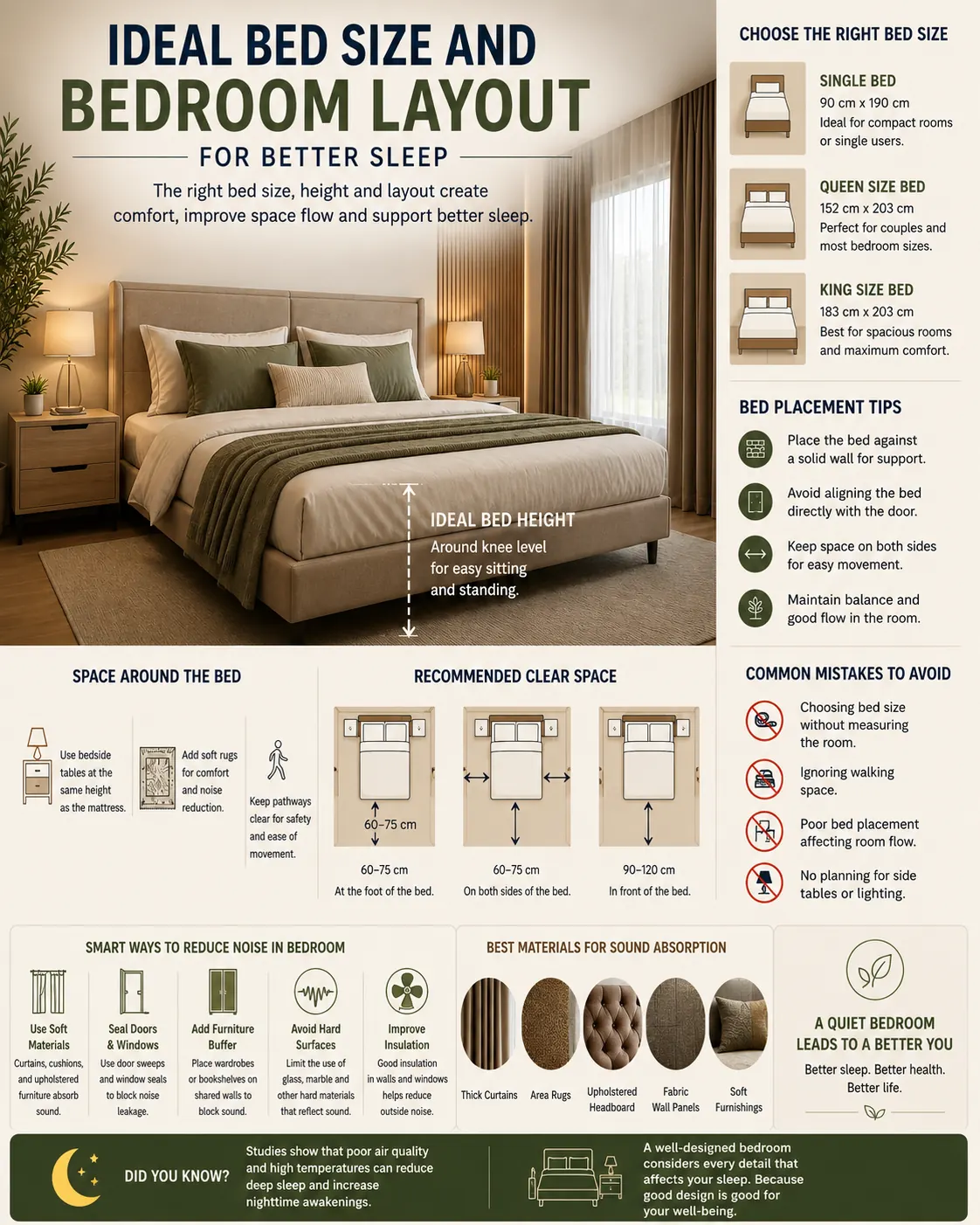
Choosing a bed size is often decided by habit, buying the same size as before, rather than by measuring the room. A bed that is slightly too big for the space can make an otherwise fine bedroom feel cramped and hard to move around in, while a bed that is too small for the room can leave it feeling empty and unbalanced.
Common Bed Sizes and Who They Suit
- Single (91 x 191 cm approx.): best for children's rooms, guest rooms, or compact bedrooms used by one person.
- Queen (152 x 191 cm approx.): the most common choice for a main bedroom shared by two people, balancing comfort and space efficiency.
- King (183 x 203 cm approx.): suited to larger main bedrooms where there is enough floor area left over for comfortable movement around the bed.
How Much Clearance Space You Actually Need
Beyond the bed's footprint, comfortable movement in a bedroom generally needs at least 60 to 90 cm of clear space on each side you walk around, and slightly more at the foot of the bed if it is also a walking path. A common mistake is measuring only the room's total floor area and forgetting to account for this clearance, which is what makes a bed feel too large for a room even when it technically fits.
Before buying, it helps to mark out the bed's actual footprint on the floor with tape and walk around it, rather than relying on the room's dimensions alone.
Placing the Bed for a Better Layout
Where possible, position the bed so its headboard is against a solid wall, away from windows and doors, which improves both comfort and how balanced the room feels. Avoid placing a bed directly in line with the door if you can help it, since it tends to make the room feel less private and harder to arrange around. In smaller rooms, pushing the bed into a corner, with one side against a wall, frees up meaningfully more usable floor space than centering it.
Matching the Bed Size to the Rest of the Room
A larger bed leaves less room for other furniture, so the size decision should factor in what else needs to fit: wardrobe, bedside tables, dressing table, or a small seating area. If storage is a priority and floor space is limited, a bed with built-in storage can offset the space a larger bed size takes up elsewhere in the room, without needing extra furniture to make up for it.
Back to Bedroom Guides